Less time. More strength. Backed by data.
 ScienceIntense Fit
How fast should you lower the bar? What an 8-week tempo squat trial found
Thirty trained students squatted twice a week for eight weeks with three different lowering speeds. The four-second group got stronger and slower. The two-second group got stronger and faster. Here is what that means if you train slow on purpose.
 ScienceIntense Fit
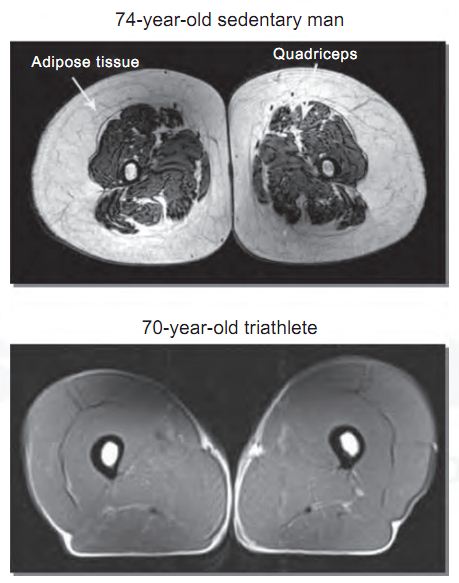
Two thighs, forty years apart: what one MRI tells us about strength training
A 74-year-old sedentary man and a 70-year-old triathlete. Same scanner, same slice, almost the same age — and a difference in muscle and fat so stark it became one of the most reproduced images in exercise medicine. Here is the story behind it, and what the research really says about using strength training to keep the body you have.
 LongevityIntense Fit
The best workout is the one you'll still be doing in thirty years
Optimal programs you abandon in six weeks beat nothing — but they lose to imperfect programs you keep doing for life. The peer-reviewed case for adherence as the single most underrated training variable.
 ScienceIntense Fit
It does not matter if you have never trained, or trained for thirty years
Nonagenarians made large strength gains in eight weeks. Lifelong lifters added muscle in their seventies. Meaningful adaptation has been reported across the lifespan, and the trials describing it have been published for thirty-five years.
 ScienceIntense Fit
Stop skipping leg day. Your legs are metabolic medicine
One workout protects your heart, improves glucose control, lowers blood pressure, and predicts how long you live. Most people skip it. Here's the cardiovascular and metabolic case for training your legs.
 ProtocolIntense Fit
The Mike Mentzer workout: Heavy Duty HIT, explained
Mike Mentzer's Heavy Duty system. One set close to failure, full recovery, ruthless progression. A deliberately minimal strength protocol built around slow cadence, time under load, and progression. Here's the routine, the logic, and how to actually run it.
 ProtocolIntense Fit
Time under tension: the honest guide to TUT, TUL, and super slow training
Time under tension (TUT) is one of the most misunderstood numbers in strength training. Here is what it actually measures, how it sits alongside load, cadence and range, and what the evidence does and does not say about very slow reps.
 ComparisonIntense Fit
Strong vs Hevy vs Intense Fit: which workout log actually fits HIT?
Three apps, three philosophies. If you train high-intensity once a week, only one of them is built for the protocol you're actually running.
 ProtocolIntense Fit
The minimum effective workout tracker
Most fitness apps measure the wrong things in stunning detail. Here's the shortest list of numbers that actually predict whether you'll still be strong at 80.
 ScienceIntense Fit
Why twelve minutes a week is enough
How a single set taken to true momentary failure can deliver more strength gain than five hours of conventional gym work.
 MythsIntense Fit
The bulky myth: why heavy lifting won't ruin your silhouette
Bulk takes elite genetics, a decade of food surplus, and usually pharmacology. One or two HIT sessions a week build the opposite. Dense, useful muscle.
 ScienceIntense Fit
Genetics decide your ceiling, not your slope
Whether you're built like a marathoner or a powerlifter, the slope of your strength curve is up to you. You can roughly double your starting strength on this protocol.
 ProtocolIntense Fit
Super slow training and the 10/10 protocol: maximum time under tension, minimum joint cost
Super slow training. Ten seconds up, ten seconds down. A demanding way to train that keeps peak joint forces lower than fast, momentum-driven reps.
 ProtocolIntense Fit
One set to failure: what true muscular failure actually feels like
Most lifters have never taken a single set to real failure. They stop at discomfort. The line between 'tired' and 'incapable' is where the whole adaptation lives.
MindIntense FitThe mind that lifts the weight is the mind you take home
Twelve minutes of voluntary, controlled suffering rewires your relationship with discomfort. The compounding effect on focus, mood, and decisions is the real prize.
 FounderIntense Fit
Why I built Intense Fit
I hated the gym, the gymbros, and the noise. Then I read one book. And started treating my body like a spreadsheet. This is the app I wished I'd had on day one.
 StoryIntense Fit
A tale of two trainees
Two people, same age, same goal. Two completely different bets. Twenty years later, only one is still standing strong.
LongevityIntense FitStrong at eighty: why grip strength predicts how long you'll live
The single best predictor of mortality past 60 isn't blood pressure or cholesterol. It's how hard you can squeeze.
 ManifestoIntense Fit
The app is not the answer. The knowledge is.
Intense Fit is a coach in your ear, not a magic pill. If you delete it tomorrow, the protocol still works. That's exactly the point. And exactly why most fitness apps will quietly fail you.
 MythsIntense Fit
The cardio cult is wrong. Or at least, badly incomplete.
Running won't keep you alive past 80. Muscle will. A hard look at the most over-prescribed exercise of the last fifty years.
 ManifestoIntense Fit
Why the fitness industry is structurally wrong
It's not a conspiracy. It's worse: it's incentives. The reason your gym, your trainer, and your favourite influencer all push the same broken advice.
 LongevityIntense Fit
Sarcopenia is reversible. At sixty, at seventy, at ninety.
The loss of muscle with age isn't a one-way road. The clinical evidence on reversing sarcopenia is, if you actually read it, almost embarrassing in its clarity.
 ScienceIntense Fit
Cardiovascular health without the cardio cult
Resistance training is, itself, a cardiovascular event. The same brutal set that builds your quads also remodels your heart. The choice between strength and heart health is a false one.
 ManifestoIntense Fit
It's not the app that changes you. It's the framework you can't unsee.
Once you understand fibre recruitment, failure, and recovery, you can't go back to volume training. Intense Fit sells that one-way door. The software is just the handle.
ScienceIntense FitIs it strength training? Pilates, yoga, calisthenics, rowing, swimming — what counts and what doesn't
Apple Watch logs Pilates as 'Functional Strength Training.' Your yoga teacher swears it builds strength. Your rowing coach says it's a full-body workout. Here's the honest line — and what actually causes a muscle to grow stronger.
ProtocolIntense FitHow much strength training per week? The honest answer is less than you've been told
ACSM says 2–3 days a week. Influencers say 5. Bodybuilders say 6. The peer-reviewed dose-response curve says the largest gains happen between zero and roughly one short session. Everything past that is shaping the last few percent.
MythsIntense FitWhat is functional strength training, really? The term is mostly marketing — here's what actually transfers
'Functional' became the most-overused word in fitness the moment Apple added it to the Workout app. The honest definition is shorter and less flattering: strength is functional when there is enough of it.
ProtocolIntense FitThe HIT workout tracker: time under load, slow cadence, and one honest set
Every popular gym-log app is built for volume training — sets, reps, rest timers, weekly tonnage. HIT training needs none of that. It needs three numbers per exercise, and the discipline to stop the moment the muscle fails. Here's what an honest HIT tracker actually records.